SERVICES

Models, Tools & Code

We design custom machine learning models, tools and code for people, researchers and companies.


How it works

Tell us what you want to predict, automate or understand. We study your data, build a model that fits the problem, and hand it over with code you can run and a plain-language explanation of how it works. You can get a quote estimate here:


Models that can run on a local device

When the job calls for it, we can build models that run on a device you control instead of sending every request to a cloud API. That can mean lower ongoing cost and data that stays in your shop.


Models we build Live

Tap a model to see what it does and where it's used.

RegressionPredicts a number

Learns how inputs relate to a number, then predicts that number for new cases.

USED FOR
  • Sales and revenue forecasts
  • Pricing
  • Delivery and wait-time estimates
ClassificationSorts things into categories

Learns from labeled examples, then decides which group something new belongs to.

USED FOR
  • Spam and fraud filters
  • Lead and customer scoring
  • Sorting support tickets
Decision TreesMakes choices with yes/no questions

Splits data with a series of simple yes/no questions until it reaches an answer, like a flowchart. Easy to read and explain.

USED FOR
  • Loan and credit approvals
  • Diagnosing customer issues
  • Explaining why a decision was made
Random ForestsMany trees voting together

Builds hundreds of decision trees on different slices of the data and combines their votes, which makes it more accurate and stable than a single tree.

USED FOR
  • Predicting customer churn
  • Fraud detection
  • Ranking which factors matter most
ClusteringFinds natural groups

Groups similar items together without needing any labels, revealing patterns you didn't know were there.

USED FOR
  • Customer segments
  • Grouping similar products
  • Organizing large document sets
Time-Series ForecastingPredicts what comes next

Studies how data changes over time, including trends and seasons, to forecast future values.

USED FOR
  • Inventory demand
  • Staffing schedules
  • Energy and resource use
Computer VisionUnderstands images and video

Uses neural networks (usually CNNs) to recognize objects, read text and spot details in pictures.

USED FOR
  • Product defect detection
  • Counting and tracking items
  • Reading forms and receipts
Language Models (NLP)Reads and writes text

Transformer models that understand and generate language. Paired with RAG, they answer from your own documents.

USED FOR
  • Chatbots and assistants
  • Summarizing documents
  • Drafting email replies
Recommendation SystemsSuggests what people want next

Learns from what people choose to predict what else they'll like.

USED FOR
  • Product recommendations
  • Personalized content
  • Smarter upsells
Anomaly DetectionSpots what's unusual

Learns what normal looks like and flags anything that doesn't fit.

USED FOR
  • Fraud alerts
  • Early warnings for failing equipment
  • Network security
Reinforcement LearningLearns by trial and reward

An agent tries actions, gets rewarded for good results, and improves its strategy over time.

USED FOR
  • Robotics and control
  • Dynamic pricing
  • Scheduling and routing
Edge AITiny models for low-power devices

Small, efficient models that run right on the device instead of in the cloud, using very little power.

USED FOR
  • Sensors and wearables
  • Drones
  • Smart farming

Past projects

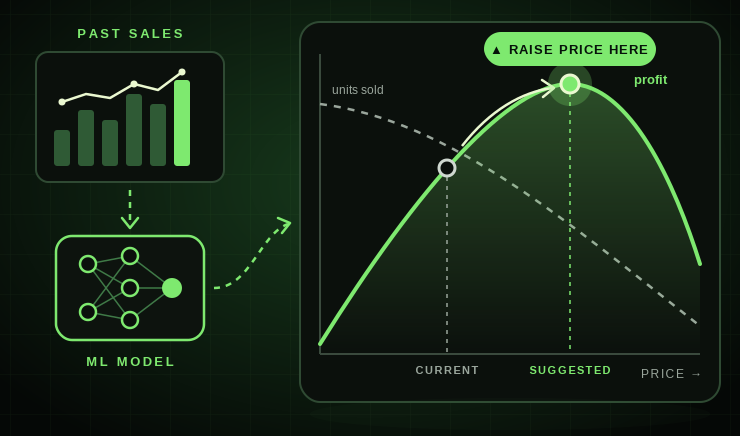
Drawing of the price optimization model: past sales data feeds a machine learning model, which points to the price at the top of the profit curve

Price Optimization Model

A machine learning model that learns from historical pricing data and suggests price changes that increase profit.

  • In use every week, suggesting price adjustments based on past sales
  • Paired with a data cleanup algorithm that prepares the sales data
  • Keeps sales high while raising the price per unit
  • Finds the price where profit is highest
Machine Learning Pricing Sales Data

Ready to build?

Tell us about your data and what you want it to do, and we'll build a model around it.